| |
The world of
pregnancy and labor has many unique terms, expressions ?and decisions.
From "Lamaze" and "epidural" to "dilation" and "episiotomy," the terms
used by doctors, midwives and nurses can often get confusing.
"Presentation" is one word doctors often use when speaking of an
impending delivery. This term is important to the actual delivery
process. Put simply, "presentation" is the position of the baby's body
when progressing down the birth canal and entering the world or, in
other words, how a baby presents itself during her entrance into the
world.
"We refer to any presentation other than the normal as being 'fetal
malpresentations,'" says Dr. David Michael, a specialist in Obstetrics
and Gynecology at Mt. Sinai Hospital in Chicago. "The incidence of these
malpresentations is only 5 percent of all births. Any deviation from the
normal, big or small, is considered a malpresentation."
There are three components that indicate whether a baby is in a normal
position or malpresentation. They include the fetal lie ?the axis of the
baby relative to that of the mother's; the presentation ?which indicates
what body part is closest to the pelvic outlet; and the flexion attitude
?which refers to how the head of the baby is flexed. Each of these
components has variations that indicate whether the baby is in a normal
presentation position or is going to come through the birth canal in an
unusual way.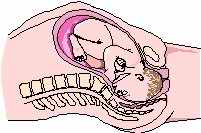
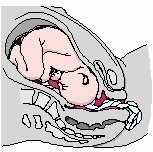
The Fetal Lie
As a mother lies on her back during delivery, her spine is vertical ?or
straight up and down. In relation malpresentation, the fetal lie
indicates the position of the baby's spine in relation to the mother's
at the time of delivery. The "normal" spinal position is called
"cephalic," meaning it is in the same direction and angle as the
mother's spine. When the baby is positioned at an angle so that the
spine is off enter from the mother's, the baby is said to have an
"oblique lie," meaning it is at an angle away from the mother's spine.
If the baby is lying in a position in which the mother's and the baby's
spines make a cross or a "T" shape, the baby is in a "transverse lie."
Although rare, the malpresentation of a fetal lie could offer
complications to the delivery process. "An oblique or transverse lie
occurs in approximately one in 300 births," says Dr. Michael. "The major
risk with a malpresentation of the fetal lie is that neither the feet or
the head occupy the pelvic outlet, allowing an open space in the birth
canal. Should a woman's water break, there is nothing plugging that
outlet or taking up of that space. The most common complication with a
malpresentation of the fetal lie is cord prolapse."
 "Cord
prolapse" is when the umbilical cord exits the birth canal prior to the
baby. If cord prolapse occurs, the blood and oxygen flow to the baby can
be interrupted or severed, which can cause tissue, organ or brain
damage.
"A cord prolapse can occur 20 times more often with a transverse lie
than with an oblique or cephalic," Dr. Michael says. "If a mother goes
into labor, especially if her water membrane breaks and she has been
told by her doctor that her baby is in a transverse lie, she should get
immediate medical attention or call 9??. Women tend to have a good
chance of having what is called an external cephalic reversion ?where
the doctor can turn the baby into a correct position. Also, a large
percentage of the mothers whose babies are in an oblique or transverse
lie will not need the doctor to help. When they go into labor and start
contracting, oftentimes the baby will revert to a vertex presentation
spontaneously. So by the time they are ready for actual delivery, the
head will have made its way down into the pelvis on its own, lining up
perfectly."
Presentation
Although the process in its entirety is also referred to as
"presentation," one of the factors that contributes to the normal
position or malpresentation of a baby during delivery is given the same
term. The component of "presentation" refers to the part of the baby
that first appears in the pelvis or birth canal. The typical
presentation of a baby during delivery is the occipital lobe, or crown
of the head, first. However, babies tend to come into the world in a
wide variety of positions. In addition, there are several variations of
each position.
Breech Presentation
A breech birth happens when a baby is born feet, knees or buttocks
first. "Breech presentation occurs in 3 to 4 percent of all deliveries,"
says Dr. Michael. "So, if there were to be a malpresentation, it would
more than likely be breech. Most babies can be breech as late as 32
weeks into the pregnancy and then move to a cephalic presentation during
the last few weeks. If a woman has an ultrasound late in her pregnancy,
up to 32 weeks and has been told her baby is in a breech position, there
really is no cause for concern. Again, oftentimes babies in the breech
position later in the pregnancy will turn themselves before labor and
delivery begin ?requiring no assistance from the doctor."
Judith Turner, a stay ome mother from Sandy, Utah, says, "My fifth baby
was breech until a week before he was born ?at 37 weeks. The plan was to
either try to turn him when I went into labor or to try a vaginal breech
delivery at the hospital instead of the birthing center. We discovered
the previous day at an ultrasound that he had already flipped."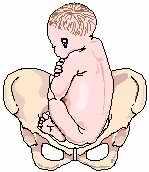
In the category of breech births, there are several positions a baby
could take. These include Frank breech, complete breech, incomplete
breech, footling and double footling. In the position of Frank breech,
the baby is in a "V" position. The buttocks and pelvis are in the birth
canal but the legs are flexed up over the baby's body. Complete breech
is when the baby is sitting "Indian style," and incomplete breech is
when the baby is sitting "Indian style" with one of the legs or feet
dangling down. A footling position is when one of the feet is extended
down toward the birth canal, and double footling is when both feet are
extended down so that the first thing into the birth canal is the feet.
"There is no real danger with this position but because the fetal
extremity is occupying space along side of the head, it may obstruct
labor, it may not allow the head to fit," Dr. Michael says. "But a
majority of the time, the baby can be allowed to go through a normal
vaginal delivery."

Compound Presentation
A compound presentation occurs when more than one part of the baby
enters the pelvic outlet or birth canal at the same time. The most
common compound presentation is the hand or arm alongside the head. The
risk with a compound presentation is related to the size of the pelvis.
If the pelvis is able to compensate for the extra room needed for a
compound presentation, the doctor may allow the birth to occur
naturally. However, if the cervix and pelvis are not able to compensate,
an episiotomy ?or a ection in extreme or emergency situations ?may be
performed.
"There is no real danger with this position but because the fetal
extremity is occupying space along side of the head, it may obstruct
labor, it may not allow the head to fit. But a majority of the time, the
baby can be allowed to go through a normal vaginal delivery," Dr.
Michael says.
Shoulder Presentation
Shoulder presentations are rare ?less than one out of every 1,000 births
?and require Cesarean section or repositioning before delivery can
continue. "Shoulder births do not happen very often and when they do,
most babies end up being delivered via ection," Dr. Michael says. "There
are very few doctors who will allow a shoulder presentation to go on
naturally or who will attempt to reposition a shoulder presentation."
Flexion Attitude
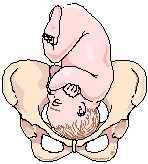
The "flexion attitude" component of birth presentation refers to the
position of the baby's head during delivery. The normal position of the
baby's head should be in a chinhest position ?with the baby's face
slightly downward as if attempting to touch the chin to the chest. When
the head is at an angle as though the baby is looking up and the head is
hyper tended, it is called a "face presentation," because the baby's
face will present itself before the rest of the head. A brow
presentation occurs when the baby's head is in a position that is
between a face presentation and a cephalic presentation. The brow
presentation is also called the "military" presentation, as the baby
appears to be imitating military personnel, standing at attention.
 "The
abnormality of the flexion attitude, or when the head is not flexed
properly, is very rare ?about one in every 500 births," Dr. Michael
says. "If someone has a baby in a malpresentation position due to
flexion attitude, the decision of the delivery will be left to the
doctor. If the doctor feels that the baby is not too big and the pelvis
is adequate, the woman can possibly have a vaginal delivery, although
the risk for a ection increases but will depend upon the view of
the doctor."
"I wasn't aware of my daughter's malpresentation until right at
delivery," says Kyle Looby, a homemaker and writer from Springfield,
Ill. "It was as she was crowning that the doctor slowed everything down
and told me she was face?a face presentation. The doctor then told me to
pant while he tried to turn her manually. Her malpresentation slowed
down delivery considerably. My daughter came out with only a couple of
bruises around her nose. The doctor told me that would go away within a
few days. Other than that, she was perfect."
During pregnancy, babies will move, flip, kick and rotate quite often.
It is not unusual for a baby to change position an average of four times
during a normal pregnancy. Mothers who fear a malpresentation should
discuss with their doctors what options are available. "Most babies will
maintain whatever position they are in for the birthing process by 34
weeks," Dr. Michael says. "Expectant mothers can simply ask their doctor
about any concerns they may have to ease their mind and have information
as to what to expect. As malpresentations are still quite rare, it's
safe to say that babies seem to know how to make their own grand
entrance all on their own."
|
|