|
Immediate newborn
conditions or problems
PROBLEMS
• The newborn has
serious conditions or problems:
- not breathing or
is gasping;
- breathing with
difficulty (less than 30 or more than 60 breaths per minute, indrawing
of the chest or grunting);
- cyanosis
(blueness);
- preterm or very
low birth weight (less than 32 weeks gestation or less than 1 500 g);
- lethargy;
- hypothermia;
- convulsions.
• The newborn has
other conditions or problems that require attention in the delivery room:
- low birth weight
(1 500–2 500 g);
- possible bacterial
infection in an apparently normal newborn whose mother had prelabour or
prolonged rupture of membranes;
- possible
congenital syphilis in newborn whose mother has a positive serologic
test for syphilis or is symptomatic.
IMMEDIATE
MANAGEMENT
Three situations require immediate management: no breathing (or gasping,
below), cyanosis (blueness) or breathing with difficulty.
NO BREATHING OR GASPING
GENERAL MANAGEMENT
• Dry the baby, remove the wet cloth and wrap the baby in a dry, warm
cloth.
• Clamp and cut the
cord immediately if not already done.
• Move the baby to a
firm, warm surface under a radiant heater for resuscitation.
• Observe standard
infection prevention practices when caring for and resuscitating a
newborn.
RESUSCITATION
Box S-8
Resuscitation equipment
|
To avoid delays
during an emergency situation, it is vital to ensure that equipment
is in good condition before resuscitation is needed:
• Have the
appropriate size masks available according to the expected size of
the baby (size 1 for a normal weight newborn and size 0 for a small
newborn).
• Block the mask by
making a tight seal with the palm of your hand and squeeze the bag:
- If you feel
pressure against your hand, the bag is generating adequate
pressure;
- If the bag
reinflates when you release the grip, the bag is functioning
properly.
|
OPENING THE AIRWAY
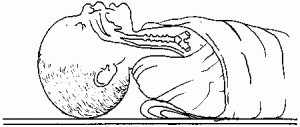
• Position the newborn (Fig S-28):
- Place the baby on
its back;
- Position the head
in a slightly extended position to open the airway;
- Keep the baby
wrapped or covered, except for the face and upper chest.
FIGURE S-28 Correct
position of the head for ventilation; note that the neck is less extended
than in adults
• Clear the airway by suctioning first the mouth and then the nostrils. If
blood or meconium is in the baby’s mouth or nose, suction
immediately to prevent aspiration.
Note: Do not
suction deep in the throat as this may cause the baby’s heart to slow or
the baby may stop breathing.
• Reassess the baby:
- If the newborn
starts crying or breathing, no further immediate action is needed.
Proceed with initial care of the newborn;
- If the baby is
still not breathing, start ventilating (see below).
VENTILATING THE
NEWBORN
• Recheck the newborn’s position. The neck should be slightly extended
(Fig S-28).
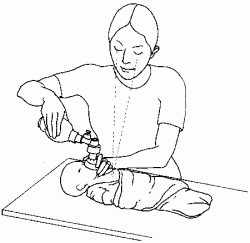
• Position the mask
and check the seal (Fig S-29):
- Place the mask on
the newborn’s face. It should cover the chin, mouth and nose;
- Form a seal
between the mask and the face;
- Squeeze the bag
with two fingers only or with the whole hand, depending on the size of
the bag;
- Check the seal by
ventilating twice and observing the rise of the chest.
FIGURE S-29
Ventilation with bag and mask
• Once a seal is ensured and chest movement is present, ventilate the
newborn. Maintain the correct rate (approximately 40 breaths per minute)
and the correct pressure (observe the chest for an easy rise and fall):
- If the baby’s
chest is rising, ventilation pressure is probably adequate;
- If the baby’s
chest is not rising:
- Recheck and
correct, if necessary, the position of the newborn (Fig S-28);
- Reposition the
mask on the baby’s face to improve the seal between mask and face;
- Squeeze the bag
harder to increase ventilation pressure;
- Repeat suction of
mouth and nose to remove mucus, blood or meconium from the airway.
• If the mother of
the newborn received pethidine or morphine prior to delivery, consider
administering naloxone after vital signs have been established (Box S-9).
• Ventilate for 1
minute and then stop and quickly assess if the newborn is breathing
spontaneously:
- If breathing is
normal (30–60 breaths per minute) and there is no indrawing of
the chest and no grunting for 1 minute, no further
resuscitation is needed. Proceed with initial care of the newborn;
- If the newborn
is not breathing, or the breathing is weak, continue
ventilating until spontaneous breathing begins.
• If the newborn
starts crying, stop ventilating and continue observing breathing for 5
minutes after crying stops:
- If breathing is
normal (30–60 breaths per minute) and there is no indrawing of
the chest and no grunting for 1 minute, no further resuscitation is
needed. Proceed with initial care of the newborn;
- If the
frequency of breathing is less than 30 breaths per minute, continue
ventilating;
- If there is
severe indrawing of the chest, ventilate with oxygen, if available
(Box S-10). Arrange to transfer the baby to the most appropriate service
for the care of sick newborns.
• If the newborn is
not breathing regularly after 20 minutes of ventilation:
- Transfer the baby
to the most appropriate service for the care of sick newborns;
- During the
transfer, keep the newborn warm and ventilated, if necessary.
• If there is no
gasping or breathing at all after 20 minutes of ventilation, stop
ventilating; the baby is stillborn. Provide emotional support to the
family.
BOX S-9
Counteracting respiratory depression in the newborn caused by narcotic
drugs
|
If the mother
received pethidine or morphine, naloxone is the antidote for
counteracting respiratory depression in the newborn caused bythese
drugs.
Note: Do not
administer naloxone to newborns whose mothers are suspected of
having recently abused narcotic drugs.
• If there are
signs of respiratory depression, begin resuscitation
immediately:
- After vital signs
have been established, give naloxone 0.1 mg/kg body weight IV to the
newborn;
- Naloxone may be
given IM after successful resuscitation if the infant has adequate
peripheral circulation. Repeated doses may be required to prevent
recurrent respiratory depression.
• If there are
no signs of respiratory depression, but pethidine or morphine
was given within 4 hours of delivery, observe the baby
expectantly for signs of respiratory depression and treat as above
if they occur. |
CARE AFTER SUCCESSFUL RESUSCITATION
• Prevent heat loss:
- Place the baby
skin-to-skin on the mother’s chest and cover the baby’s body and head;
- Alternatively,
place the baby under a radiant heater.
• Examine the newborn
and count the number of breaths per minute:
- If the baby is
cyanotic (bluish) or is having difficulty breathing (less
than 30 or more than 60 breaths per minute, indrawing of the chest or
grunting), give oxygen by nasal catheter or prongs (below).
• Measure the baby’s
axillary temperature:
- If the
temperature is 36°C or more, keep the baby skin-to-skin on the
mother’s chest and encourage breastfeeding;
- If the
temperature is less than 36°C, rewarm the baby.
• Encourage the mother
to begin breastfeeding. A newborn that required resuscitation is at higher
risk of developing hypoglycaemia:
- If suckling is
good, the newborn is recovering well;
- If suckling is
not good, transfer the baby to the appropriate service for the care
of sick newborns.
• Ensure frequent
monitoring of the newborn during the next 24 hours. If signs of
breathing difficulties recur, arrange to transfer the baby to the most
appropriate service for the
care of sick newborns.
CYANOSIS OR BREATHING DIFFICULTY
• If the baby is cyanotic (bluish) or is having difficulty
breathing (less than 30 or more than 60 breaths per minute, indrawing of
the chest or grunting) give oxygen by nasal catheter or prongs:
- Suction the mouth
and nose to ensure the airways are clear;
- Give oxygen at 0.5
L per minute by nasal catheter or nasal prongs (Box S-10);
- Transfer the baby
to the appropriate service for the care of sick newborns.
• Ensure that the baby
is kept warm. Wrap the baby in a soft, dry cloth, cover with a blanket and
ensure the head is covered to prevent heat loss.
Box S-10 Use of
oxygen
|
When using oxygen,
remember:
• Supplemental
oxygen should only be used for difficulty in breathing or cyanosis;
• If the baby is
having severe indrawing of the chest, is gasping for
breath or is persistently cyanotic, increase the
concentration of oxygen by nasal catheter, nasal prongs or oxygen
hood.
Note:
Indiscriminate use of supplemental oxygen for premature infants has
been associated with the risk of blindness. |
ASSESSMENT
Many serious conditions in newborns—bacterial infections, malformations,
severe asphyxia and hyaline membrane disease due to preterm birth—present
in a similar way with difficulty in breathing, lethargy and poor or no
feeding.
It is difficult to
distinguish between the conditions without diagnostic methods.
Nevertheless, treatment must start immediately even without a clear
diagnosis of a specific cause. Babies with any of these problems should
be suspected to have a serious condition and should be transferred without
delay to the appropriate service for the care of sick newborns.
MANAGEMENT
VERY LOW BIRTH WEIGHT OR VERY PRETERM BABY
If the baby is very small (less than 1 500 g or less than 32
weeks), severe health problems are likely and include difficulty in
breathing, inability to feed, severe jaundice and infection. The baby is
susceptible to hypothermia without special thermal protection (e.g.
incubator).
Very small newborns
require special care. They should be transferred to the appropriate
service for caring for sick and small babies as early as possible. Before
and during transfer:
• Ensure that the baby
is kept warm. Wrap the baby in a soft, dry cloth, cover with a blanket and
ensure the head is covered to prevent heat loss.
• If maternal
history indicates possible bacterial infection, give first dose of
antibiotics:
- gentamicin 4 mg/kg
body weight IM (or give kanamycin);
- PLUS ampicillin
100 mg/kg body weight IM (or give benzyl penicillin).
• If the baby is
cyanotic (bluish) or is having difficulty breathing (less than 30 or
more than 60 breaths per minute, indrawing of the chest or grunting), give
oxygen by nasal catheter or prongs.
LETHARGY
If the baby is lethargic (low muscular tone, does not move), it is
very likely that the baby has a severe illness and should be transferred
to the appropriate service for the care of sick
of newborns.
HYPOTHERMIA
Hypothermia can occur quickly in a very small baby or a baby who was
resuscitated or separated from the mother. In these cases, temperature may
quickly drop below 35°C. Rewarm
the baby as soon as possible:
• If the baby is
very sick or is very hypothermic (axillary temperature less than
35°C):
- Use available
methods to begin warming the baby (incubator, radiant heater, warm room,
heated bed);
- Transfer the baby
as quickly as possible to the appropriate service for the care of
preterm or sick newborns;
- If the baby is
cyanotic (bluish) or is having difficulty breathing (less
than 30 or more than 60 breaths per minute, indrawing of the chest or
grunting), give oxygen by nasal catheter or prongs (page S-146).
• If the baby is
not very sick and axillary temperature is 35°C or more:
- Ensure that the
baby is kept warm. Wrap the baby in a soft, dry cloth, cover with a
blanket and ensure the head is covered to prevent heat loss;
- Encourage the
mother to begin breastfeeding as soon as the baby is ready;
- Monitor axillary
temperature hourly until normal;
- Alternatively, the
baby can be placed in an incubator or under a radiant heater.
CONVULSIONS
Convulsions in the first hour of life are rare. They could be caused by
meningitis, encephalopathy or severe hypoglycaemia.
• Ensure that the baby
is kept warm. Wrap the baby in a soft, dry cloth, cover with a blanket and
ensure the head is covered to prevent heat loss.
• Transfer the baby to
the appropriate service for the care of sick newborns as quickly as
possible.
MODERATELY PRETERM
OR LOW BIRTH WEIGHT BABY
Moderately preterm (33–38 weeks) or low birth weight (1 500–2 500 g)
babies may start to develop problems soon after birth.
• If the baby has
no breathing difficulty and remains adequately warm while in
skin-to-skin contact with the mother:
- Keep the baby with
the mother;
- Encourage the
mother to initiate breastfeeding within the first hour if possible.
• If the baby is
cyanotic (bluish) or is having difficulty breathing (less than
30 or more than 60 per minute, indrawing of the chest or grunting), give
oxygen by nasal catheter or prongs.
• If axillary
temperature drops below 35°C, rewarm the baby.
PRETERM AND/OR PROLONGED RUPTURE OF MEMBRANES AND AN ASYMPTOMATIC
NEWBORN
The following are suggested guidelines which may be modified according to
local situations:
• If the mother has
clinical signs of bacterial infection or if membranes were ruptured
for more than 18 hours before delivery even if the mother has no
clinical signs of infection:
- Keep the baby with
the mother and encourage her to continue breastfeeding;
- Make arrangements
with the appropriate service that cares for sick newborns to take a
blood culture and start the newborn on antibiotics.
• If these
conditions are not met, do not treat with antibiotics. Observe the
baby for signs of infection for three days:
- Keep the baby with
the mother and encourage her to continue breastfeeding;
- If signs of
infection occur within 3 days, make arrangements with the
appropriate service that cares for sick newborns to take a blood culture
and start the newborn on antibiotics.
CONGENITAL SYPHILIS
• If the newborn shows signs of syphilis, transfer the baby to the
appropriate service for the care of sick newborns. Signs of syphilis
include:
- generalized oedema;
- skin rash;
- blisters on palms
or soles;
- rhinitis;
- anal condylomata;
- enlarged
liver/spleen;
- paralysis of one
limb;
- jaundice;
- pallor;
- spirochetes seen
on darkfield examination of lesion, body fluid or cerebrospinal fluid.
• If the mother has
a positive serologic test for syphilis or is symptomatic but the
newborn shows no signs of syphilis, whether or not the mother was
treated, give benzathine penicillin 50 000 units/kg body weight IM as a
single dose.
新生兒急救(Neonatal
Resuscitation)
Apgar Score:
|
|
0 |
1 |
2 |
|
Color(皮膚顏色) |
Blue,Pale |
Acrocyanosis |
Pink |
|
Pulse(心跳速率) |
Abscent |
<100 |
>100 |
|
Grimace(皺鼻反應) |
No response |
Weak response |
Vigorous |
|
Tone(肌肉緊張度) |
Flaccid |
Flexion of extremities |
Active movement |
|
Respiration(呼吸效率) |
Abscent |
Gasping |
Crying |
Initial stabililzation:
1.
Enviroment: Warm & Dry
2.
Positioning: Sniffing Position
3.
Suction:
60~80mm
Hg pressure; mouth first,then nose.
4.
Tactile stimulation
Resuscitation:
Oxygen administration-5L/min
Ventilation-40~60/min;
pressuure
20~70
cmH2O
initially,then
20~30
cmH2O.
|
Approximate O2 |
Tubing |
Mask |
|
Comcentration(%) |
|
|
|
60 |
1/2
inch from nares |
Mask held firmly on face |
|
60 |
1
inch from nares |
Mask held firmly on face |
|
40 |
2
inches from nares |
Mask held loosely on face |
Endotracheal Tube Size and Depth Of Insertion:
|
Weight |
Gestational Age |
Size |
|
<100gm |
<28
wks |
2.5
mm |
|
1000~2000
gm |
28
~
34
wks |
3.0
mm |
|
2000~3000
gm |
34
~
38
wks |
3.5
mm |
|
>3000
gm |
>38
wks |
3.5
~
4.0
mm |
|
|
|
Weight |
Depth of Insertion (from upper lip) |
|
1
kg |
7
cm |
|
2
kg |
8
cm |
|
3
kg |
9
cm |
|
4
kg |
10
cm
|
Neonatal Resuscitation Supplies and Equipment
1.
Suction equipment
Bulb syringe
Suction catheter
5,8,
10
Fr
Wall suction set at low continuous suction (60
to
80
mmHg)
8-Fr
feeding tube and
20-ml
syringe
Meconium aspirator if available or
10-Fr
suction Catheter
2.
Bag and Mask equipment
250
ml premature infant resuscitation bag capable of delivering
90%
to
100%
oxygen
450ml
term infant resuscitation bag, capable of delivering
90%
to
100%oxygen
Face masks: premature and newborn size(cushioned rims)
Oxygen with flow meter and tubing
Oral airways: newborn and premature sizes
3.
Intubation Equipment
Laryngoscope with straight blades: No
0
(premature)& No.1
(newborn)
Extra bulbs and batteries for laryngoscope
Endotracheal tubes:2.5,3.0,3.5,4.0
mm
Stylet
4.
Medications
Epinephrine
1:10,000
Naloxone
1
mg/ml
Volume expanders (one or more of these)
Normal saline
Ringer’s lactate
Albumin
5%
solution
O-negative blood
Sodium bicarbonate
8.4%
solution (1
mEq/ml) to be diluted
1:1
with sterile water (0.5
mEq/ml)
Detrose
10%
or Detrose
25%
(to be diluted
1:1
with sterile water)
Sterile water
5.
Miscellaneous
Radiant warmer
Adhesive tape
Syringes:
1,
3,
5,
10,
20,
50
ml
Needles:
25,
21,
18
g
Intravenous catheters:
24,
22
g
Alcohol and betadine sponges
Benzoline spray
Umbillical tape
Umbillical catheters:
3.5,
5.0
Fr
3-way
stopcock
5
Fr feeding tube
Warm blankets and towels
Cord clamps
|