|
Vaginal bleeding after
childbirth
Vaginal bleeding in
excess of 500 mL after childbirth is defined as postpartum haemorrhage (PPH).
There are, however, some problems with this definition:
• Estimates of blood
loss are notoriously low, often half the actual loss. Blood is mixed with
amniotic fluid and sometimes with urine. It is dispersed on sponges,
towels and linens, in buckets and on the floor.
• The importance of a
given volume of blood loss varies with the woman’s haemoglobin level. A
woman with a normal haemoglobin level will tolerate blood loss that would
be fatal for an anaemic woman.
Even healthy, non-anaemic
women can have catastrophic blood loss.
• Bleeding may occur
at a slow rate over several hours and the condition may not be recognized
until the woman suddenly enters shock.
Risk assessment in the
antenatal period does not effectively predict those women who will have
PPH. Active management of the third stage should be practiced on all
women in labour since it reduces the incidence of PPH due to uterine atony
. All postpartum women must be closely monitored to determine those that
have PPH.
PROBLEMS
• Increased vaginal
bleeding within the first 24 hours after childbirth (immediate PPH).
• Increased vaginal
bleeding following the first 24 hours after childbirth (delayed PPH).
Continuous slow
bleeding or sudden bleeding is an emergency; intervene early and
aggressively.
GENERAL MANAGEMENT
• SHOUT FOR HELP.
Urgently mobilize all available personnel.
• Make a rapid
evaluation of the general condition of the woman including vital signs
(pulse, blood pressure, respiration, temperature).
• If shock is
suspected, immediately begin treatment. Even if signs of shock are not
present, keep shock in mind as you evaluate the woman further because her
status may worsen rapidly. If shock develops, it is important to
begin treatment immediately.
• Massage the uterus
to expel blood and blood clots. Blood clots trapped in the uterus will
inhibit effective uterine contractions.
• Give oxytocin 10
units IM.
• Start an IV infusion
and infuse IV fluids.
• Catheterize the
bladder.
• Check to see if the
placenta has been expelled and examine the placenta to be certain it is
complete (Table S-7).
• Examine the cervix,
vagina and perineum for tears.
• After bleeding is
controlled (24 hours after bleeding stops), determine haemoglobin or
haematocrit to check for anaemia:
- If haemoglobin is
below 7 g/dL or haematocrit is below 20% (severe anaemia):
- Give ferrous
sulfate or ferrous fumerate 120 mg by mouth PLUS folic acid 400 mcg by
mouth once daily for 3 months;
- After 3 months,
continue supplementation with ferrous sulfate or ferrous fumerate 60 mg
by mouth PLUS folic acid 400 mcg by mouth once daily for 6 months.
- If haemoglobin is
between 7–11 g/dL, give ferrous sulfate or ferrous fumerate 60 mg by
mouth PLUS folic acid 400 mcg by mouth once daily for 6 months;
- Where hookworm is
endemic (prevalence of 20% or more), give one of the following
anthelmintic treatments:
- albendazole 400 mg
by mouth once;
- OR mebendazole 500
mg by mouth once or 100 mg two times per day for 3 days;
- OR levamisole 2.5
mg/kg body weight by mouth once daily for 3 days;
- OR pyrantel 10
mg/kg body weight by mouth once daily for 3 days.
- If hookworm is
highly endemic (prevalence of 50% or more), repeat the anthelmintic
treatment 12 weeks after the first dose.
DIAGNOSIS
TABLE S-7 Diagnosis
of vaginal bleeding after childbirth
|
Presenting Symptom and Other Symptoms and Signs Typically Present |
Symptoms and Signs Sometimes Present |
Probable Diagnosis |
• Immediate PPHa
• Uterus soft and not contracted |
• Shock |
Atonic uterus |
|
• Immediate PPHa
|
• Complete placenta
• Uterus contracted |
Tears of cervix,
vagina or perineum |
|
• Placenta not
delivered within 30 minutes after delivery |
• Immediate PPHa
• Uterus contracted |
Retained placenta |
|
• Portion of
maternal surface of placenta missing or torn membranes with vessels |
• Immediate PPHa
• Uterus contracted |
Retained placental
fragments |
• Uterine fundus
not felt on abdominal palpation
• Slight or intense pain |
• Inverted uterus
apparent at vulva
• Immediate PPHb |
Inverted uterus |
• Bleeding occurs
more than 24 hours after delivery
• Uterus softer and larger than expected for elapsed time since
delivery |
• Bleeding is
variable (light or heavy, continuous or irregular)
and foul-smelling
• Anaemia |
Delayed PPH |
• Immediate PPHa
(bleeding is intra-abdominal and/or vaginal)
• Severe abdominal pain (may decrease after rupture) |
• Shock
• Tender abdomen
• Rapid maternal pulse |
Ruptured uterus |
a
Bleeding may be light if a clot blocks the cervix or if the woman is lying
on her back.
b There may be no bleeding with complete inversion.
MANAGEMENT
ATONIC UTERUS
An atonic uterus fails to contract after delivery.
•
Continue to massage the uterus.
• Use
oxytocic drugs which can be given together or sequentially (Table S-8).
TABLE
S-8 Use of oxytocic drugs
| |
Oxytocin |
Ergometrine/ Methyl-ergometrine |
15-methyl Prostaglandin F2α |
|
Dose and route |
IV: Infuse 20 units
in 1 L IV fluids at 60 drops per minute
IM: 10 units |
IM or IV (slowly):
0.2 mg |
IM: 0.25 mg |
|
Continuing dose |
IV: Infuse 20 units
in 1 L IV fluids at 40 drops
per minute |
Repeat 0.2 mg IM
after 15 minutes
If required, give 0.2 mg IM or IV (slowly) every
4 hours |
0.25 mg every 15
minutes |
|
Maximum dose |
Not more than 3 L
of IV fluids containing oxytocin |
5 doses (Total 1.0
mg) |
8 doses (Total 2
mg) |
Precautions/
Contrain-dications |
Do not give as an
IV bolus |
Pre-eclampsia,
hypertension, heart disease |
Asthma |
Prostaglandins
should not be given intravenously. They may be fatal.
• Anticipate the need
for blood early, and transfuse as necessary.
• If bleeding
continues:
- Check placenta
again for completeness;
- If there are
signs of retained placental fragments (absence of a portion of
maternal surface or torn membranes with vessels), remove remaining
placental tissue;
- Assess clotting
status using a bedside clotting test. Failure of a clot to form after 7
minutes or a soft clot that breaks down easily suggests coagulopathy.
• If bleeding
continues in spite of management above:
- Perform bimanual
compression of the uterus (Fig S-4):
- Wearing high-level
disinfected gloves, insert a hand into the vagina and form a fist;
- Place the fist
into the anterior fornix and apply pressure against the anterior wall of
the uterus;
- With the other
hand, press deeply into the abdomen behind the uterus, applying pressure
against the posterior wall of the uterus;
- Maintain
compression until bleeding is controlled and the uterus contracts.
FIGURE S-4 Bimanual
compression of the uterus

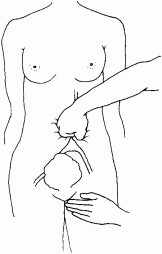
- Alternatively,
compress the aorta (Fig S-5):
- Apply downward
pressure with a closed fist over the abdominal aorta directly through the
abdominal wall:
- The point of
compression is just above the umbilicus and slightly to the left;
- Aortic pulsations
can be felt easily through the anterior abdominal wall in the immediate
postpartum period.
- With the other hand,
palpate the femoral pulse to check the adequacy of compression:
- If the pulse is
palpable during compression, the pressure exerted by the fist is
inadequate;
- If the femoral
pulse is not palpable, the pressure exerted is adequate;
- Maintain compression
until bleeding is controlled.
FIGURE S-5
Compression of abdominal aorta and palpation of femoral pulse
Packing the uterus is
ineffective and wastes precious time.
• If bleeding
continues in spite of compression:
- Perform uterine
and utero-ovarian artery ligation;
- If
life-threatening bleeding continues after ligation, perform subtotal
hysterectomy.
TEARS OF CERVIX,
VAGINA OR PERINEUM
Tears of the birth
canal are the second most frequent cause of PPH. Tears may coexist with
atonic uterus. Postpartum bleeding with a contracted uterus is usually due
to a cervical or vaginal tear.
• Examine the woman
carefully and repair tears to the cervix or vagina and perineum.
• If bleeding
continues, assess clotting status using a bedside clotting test.
Failure of a clot to form after 7 minutes or a soft clot that breaks down
easily suggests
coagulopathy.
RETAINED PLACENTA
There may be no
bleeding with retained placenta.
• If you can see
the placenta, ask the woman to push it out. If you can feel the
placenta in the vagina, remove it.
• Ensure that the
bladder is empty. Catheterize the bladder, if necessary.
• If the placenta
is not expelled, give oxytocin 10 units IM if not already done for
active management of the third stage.
Do not give
ergometrine because it causes tonic uterine contraction, which may delay
expulsion.
• If the placenta
is undelivered after 30 minutes of oxytocin stimulation and the
uterus is contracted, attempt controlled cord traction.
Note: Avoid
forceful cord traction and fundal pressure as they may cause uterine
inversion.
• If controlled
cord traction is unsuccessful, attempt manual removal of placenta.
Note: Very
adherent tissue may be placenta accreta. Efforts to extract a placenta
that does not separate easily may result in heavy bleeding or uterine
perforation which usually requires hysterectomy.
• If bleeding
continues, assess clotting status using a bedside
clotting test. Failure of a clot to form after 7 minutes or a soft
clot that breaks down easily suggests
coagulopathy.
• If there are
signs of infection (fever, foul-smelling vaginal discharge),
give antibiotics as for metritis.
RETAINED PLACENTAL
FRAGMENTS
There may be no
bleeding with retained placental fragments.
When a portion of the
placenta—one or more lobes—is retained, it prevents the uterus from
contracting effectively.
• Feel inside the
uterus for placental fragments. Manual exploration of the uterus is
similar to the technique described for
removal of the retained placenta.
• Remove placental
fragments by hand, ovum forceps or large curette.
Note: Very
adherent tissue may be placenta accreta. Efforts to extract fragments that
do not separate easily may result in heavy bleeding or uterine perforation
which usually requires hysterectomy.
• If bleeding
continues, assess clotting status using a bedside
clotting test. Failure of a clot to form after 7 minutes or a soft
clot that breaks down easily suggests
coagulopathy.
INVERTED UTERUS
The uterus is said to
be inverted if it turns inside-out during delivery of the placenta.
Repositioning the uterus should be performed immediately. With the
passage of time the constricting ring around the inverted uterus becomes
more rigid and the uterus more engorged with blood.
• If the woman is
in severe pain, give pethidine 1 mg/kg body weight (but not more than
100 mg) IM or IV slowly or give morphine 0.1 mg/kg body weight IM.
Note: Do not
give oxytocic drugs until the inversion is corrected.
• If bleeding
continues, assess clotting status using a bedside
clotting test. Failure of a clot to form after 7 minutes or a soft
clot that breaks down easily suggests
coagulopathy.
•
Give a single dose of prophylactic antibiotics after correcting the
inverted uterus:
- ampicillin 2 g IV
PLUS metronidazole 500 mg IV;
- OR cefazolin 1 g
IV PLUS metronidazole 500 mg IV.
• If there are
signs of infection (fever, foul-smelling vaginal discharge),
give antibiotics as for metritis.
• If necrosis is
suspected, perform vaginal hysterectomy. This may require referral to
a tertiary care centre.
DELAYED (“SECONDARY”) POSTPARTUM HAEMORRHAGE
• If anaemia is
severe (haemoglobin less than 7 g/dL or haematocrit less than 20%),
arrange for a transfusion and
provide oral iron and folic acid.
• If there are
signs of infection (fever, foul-smelling vaginal discharge),
give antibiotics as for metritis.
Prolonged or delayed
PPH may be a sign of metritis.
• Give oxytocic drugs
(Table S-8).
• If the cervix is
dilated, explore by hand to remove large clots and placental
fragments.
Manual exploration of the uterus is similar to the technique described for
removal of the retained placenta.
• If the cervix is
not dilated,
evacuate the uterus to remove placental fragments.
• Rarely, if
bleeding continues, consider
uterine and utero-ovarian artery ligation or
hysterectomy.
• Perform histologic
examination of curettings or hysterectomy specimen, if possible, to rule
out trophoblastic tumour.
|